Introduction
Manufacturers face a critical choice when specifying nickel plating: electroless or electrolytic. This decision directly affects part performance, production cost, and long-term durability. Many companies struggle with uneven coatings on complex geometries, premature corrosion in harsh environments, and cost overruns from choosing the wrong process. The stakes are real: a decorative cosmetic cap requires entirely different plating characteristics than a precision aerospace component or an oil-and-gas valve.
Getting that choice right starts with understanding how both processes actually work. This article breaks down each method's performance trade-offs, cost implications, and real-world applications — so you can choose the right process for your part's functional and aesthetic requirements.
Key Takeaways
- Electroless nickel uses a chemical reaction (no electricity) to deposit uniform nickel-phosphorus alloy on any substrate, making it ideal for complex geometries
- Electrolytic nickel uses electric current to deposit near-pure nickel, running faster and at lower cost for decorative finishes and conductive parts
- Electroless wins on uniformity, corrosion resistance, and substrate flexibility; electrolytic wins on speed, cost, and conductivity
- Best choice depends on geometry complexity, performance requirements, substrate material, and budget
- When geometry is complex or coating uniformity is critical, electroless is typically the safer call
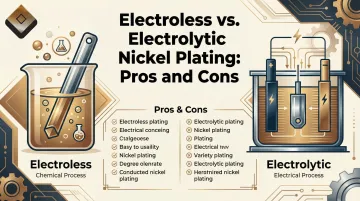
Electroless vs. Electrolytic Nickel Plating: Quick Comparison
The table below covers the key decision factors at a glance.
| Factor | Electroless Nickel | Electrolytic Nickel |
|---|---|---|
| Process | Autocatalytic chemical reaction, no external electricity | DC current through conductive bath |
| Coating Uniformity | Even deposit on all wetted surfaces, including complex geometries | Thicker on edges/corners (dog-bone effect), thinner in recesses |
| Composition | Nickel-phosphorus alloy (1-13% phosphorus content) | Near-pure or pure nickel |
| Corrosion Resistance | Superior, especially high-phosphorus variants | Moderate, varies by bath composition |
| Wear Resistance | Excellent after heat treatment (~90% hardness of hard chrome) | Lower (typically <300 HV microhardness) |
| Cost & Speed | Higher operational costs, slower deposition | Less expensive, faster for high-volume production |
| Substrate Requirements | Works on non-conductive substrates (plastics, ceramics) | Requires electrically conductive substrates only |
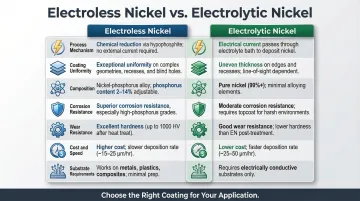
The dog-bone effect matters most for tight-tolerance parts — thickness on exposed edges can run 2–3× greater than in recessed areas, which directly affects dimensional fit and corrosion coverage in precision assemblies.
What is Electroless Nickel Plating?
Electroless nickel plating (ENP) is an autocatalytic deposition process. The substrate is immersed in a solution containing nickel salt and a reducing agent (typically sodium hypophosphite), triggering a chemical reaction that deposits a nickel-phosphorus alloy uniformly on all wetted surfaces—no external electricity required.
Phosphorus Content Matters
The phosphorus content determines performance characteristics and falls into three tiers:
- Low phosphorus (1–3%): Maximum hardness and wear resistance
- Medium phosphorus (4–9%): Balanced corrosion protection, most commonly used
- High phosphorus (10–13%): Superior resistance to highly corrosive environments like oil and gas or semiconductor manufacturing
Performance Benefits
Electroless nickel delivers distinct operational advantages:
- Uniform deposit tolerances of ±0.0001 inches eliminate post-plate machining on critical dimensions
- High-phosphorus variants resist aggressive chemical environments, including acids and chlorides
- Heat treatment post-plating can increase hardness to approximately 90% of hard chromium
- Enhanced lubricity reduces the coefficient of friction, Enhanced lubricity reduces the coefficient of friction, which matters for moving parts, tooling, and any application where galling must be prevented
The resulting nickel-phosphorus alloy forms a dense, non-porous barrier — one that consistently outperforms pure nickel in salt spray and acidic environment testing. That corrosion resistance is a key reason ENP shows up across demanding industries.
Use Cases of Electroless Nickel Plating
ENP fits best where precision and performance are non-negotiable:
Part Types:
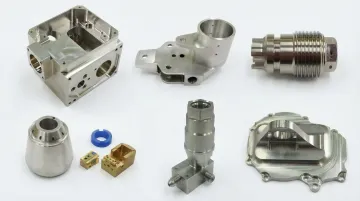
- Precision-machined components with tight tolerances
- Complex geometries (threaded parts, bores, blind holes)
- Non-conductive substrates like plastics requiring functional or protective coating
Industries:
- Aerospace: Landing gear components
- Oil and Gas: Valves and downhole tools
- Medical Devices: Surgical instruments and implantable components
- Semiconductor Equipment: Process chambers and wafer handling
- Automotive: Precision fuel system parts
- Industrial Tooling: Molds and dies
What is Electrolytic Nickel Plating?
Electrolytic nickel plating submerges the substrate (cathode) in an electrolyte bath alongside nickel anodes. An external DC current drives nickel ions to migrate and deposit onto the surface.
Because the process relies on electron flow to reduce nickel cations into metallic nickel, the substrate must be electrically conductive.
Two Primary Types
Type I (Sulfamate Nickel):
- Dull, highly ductile deposit
- Meets AMS 2424 specifications
- 99.9% pure nickel, devoid of organic brighteners
- Residual stress: 5 ksi compression to 15 ksi tension
- Used for soldering, brazing, and welding applications
- Withstands firing temperatures up to 1,832°F
Type II (Bright Nickel):
- Chrome-like appearance
- Uses Watts bath with organic additives
- Higher tensile stress, reduced ductility
- Decorative topcoat applications
- Unsuitable for high-temperature or mechanical deformation
Performance Characteristics
Near-pure or pure nickel deposit provides:
- Excellent electrical conductivity (superior to electroless nickel)
- High ductility meeting or exceeding AMS 2424 specifications
- Heat resistance for Type I deposits up to 1,832°F
- Microhardness typically below 300HV (softer than electroless nickel)
The dog-bone effect remains the primary limitation: uneven deposit thickness affects dimensional tolerances and reduces corrosion resistance in thinner areas.
Use Cases of Electrolytic Nickel Plating
These performance characteristics make electrolytic plating well-suited for applications where speed, throughput, and functional properties outweigh the need for uniform deposit thickness.
Applications:
- High-volume decorative work (cosmetic packaging, jewelry, lighting fixtures)
- Electronic components requiring high conductivity
- Parts where ductility and weldability matter more than corrosion uniformity
- Underlayer for subsequent coatings like chrome or gold
Providence Metallizing Company applies electrolytic nickel plating across many of these use cases, including matching bright and satin nickel finishes on both metal and plastic components for cosmetic and personal care clients. Their plating-on-plastic line handles over 30 finishes on substrates ranging from ABS and polycarbonate to engineering-grade plastics like Ultem, Nylon, and LCP.
Electroless vs. Electrolytic Nickel Plating: Which One Should You Choose?
The right choice depends on six key factors: part geometry complexity, required coating uniformity, substrate material, performance requirements (wear, corrosion, conductivity), production volume, and total cost of ownership.
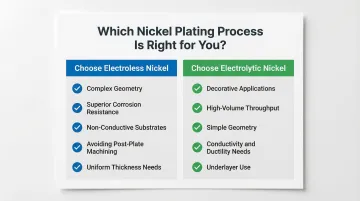
Choose Electroless Nickel When:
- Parts have complex shapes, blind holes, internal threads, or tight dimensional tolerances
- Superior corrosion resistance is non-negotiable (oil and gas, medical, aerospace)
- Substrate is non-conductive (plating on plastic, ceramics)
- Post-plate machining costs must be avoided
- Uniform coating thickness is critical to function
Choose Electrolytic Nickel When:
- Application is primarily decorative or aesthetic with less demanding performance specs
- High-volume throughput and cost efficiency are priorities
- Part has relatively simple geometry
- Ductility, conductivity, and solderability are primary performance drivers (electronic connectors, cosmetic packaging)
- Part will serve as an underlayer for additional coatings
Hybrid Scenarios
Some applications combine both methods. Electrolytic nickel can serve as an underlayer for adhesion and conductivity, then receive functional or decorative coatings on top. In cosmetic packaging specifically, this layered approach lets brands achieve a bright electrolytic finish on the surface while the underlying system handles adhesion to plastic substrates—without sacrificing either aesthetics or durability.
Not sure which method fits your application? Providence Metallizing Company has been navigating these decisions with manufacturers and brands since 1951—across industries from medical and automotive to cosmetic packaging. We offer free sampling for most applications and can match metal finishes across plastic and metal substrates. Reach us at 401-722-5300 or inquiries@providencemetallizing.com.
Conclusion
Neither electroless nor electrolytic nickel plating is universally superior. The right choice depends entirely on your application:
- Choose electroless when precision, uniform coverage on complex geometry, and corrosion resistance matter most
- Choose electrolytic when throughput speed, lower cost, and decorative finish quality take priority
The decision directly affects long-term part durability, production costs, and finish quality. Matching the process to the part — rather than defaulting to a familiar method — is what separates adequate finishing from finishing that performs.
Frequently Asked Questions
What is the difference between electroless and electrolytic nickel plating?
Electroless plating uses a chemical reaction to deposit a nickel-phosphorus alloy without electricity, producing uniform coating on all surfaces. Electrolytic plating uses electric current to deposit near-pure nickel, resulting in uneven thickness (thicker on edges, thinner in recesses).
When to use electroless nickel plating?
Electroless nickel plating is best suited for parts with complex geometries, tight tolerances, or non-conductive substrates. It excels in applications requiring superior corrosion resistance, wear resistance, or coating uniformity—including aerospace, medical, oil and gas, and precision industrial parts.
Is electroless nickel the same as nickel plating?
While both deposit a nickel layer, electroless nickel plating is a specific autocatalytic method that produces a nickel-phosphorus alloy without electricity. "Nickel plating" broadly refers to any nickel deposition method, including the more common electrolytic (electroplating) process.
Is electroless nickel coating conductive?
Electroless nickel is electrically conductive, but its conductivity is lower than electrolytic (pure) nickel due to phosphorus in the alloy. Electrolytic nickel is the preferred choice for applications where maximum electrical conductivity is required.
Is electroless nickel plating magnetic?
Magnetic properties depend on phosphorus content: low-phosphorus deposits are ferromagnetic (magnetic), while high-phosphorus deposits (above 10.5%) are amorphous and essentially non-magnetic, which makes them well suited for electronic and EMI shielding applications.
What is the best plating for corrosion resistance?
High-phosphorus electroless nickel plating ranks among the top choices for corrosion resistance among nickel-based platings. The amorphous nickel-phosphorus alloy creates a dense, non-porous barrier; for demanding environments, it can be further enhanced with appropriate post-treatments.