Introduction
Gold finishes look similar on the shelf. In production, they behave very differently. PVD coating and traditional gold plating both deliver the metallic aesthetic brands demand, yet they diverge sharply on durability, process complexity, cost structure, and substrate compatibility.
The stakes are real. According to the World Gold Council, technology sector demand for gold reached 326 tonnes in 2024, a 7% year-over-year increase driven by electronics, medical devices, and premium consumer products. That growth means more engineers and buyers are making this exact call — and getting it wrong costs in warranty claims, rework, and failed compliance audits.
Your choice between PVD and electroplating directly shapes product lifespan, environmental compliance, and brand perception.
This guide covers the key technical differences, performance trade-offs, and situational recommendations to help you select the right finishing method for your application—whether you're developing luxury cosmetic packaging, high-cycle electronic connectors, or architectural hardware.
Key Takeaways
- PVD coating bonds metal particles at a molecular level in a vacuum chamber, creating an exceptionally hard, scratch-resistant, tarnish-proof finish ideal for high-wear consumer products
- Gold plating deposits gold ions electrochemically in a wet bath, covering complex geometries with precise thickness control; it remains the standard for electronics and medical applications
- PVD coatings typically outlast gold plating by years under daily wear, though heavy gold deposits (2.5+ microns) narrow this gap significantly
- PVD carries higher upfront equipment costs but lower lifecycle costs; gold plating has a lower entry price with recurring re-plating expenses
- Neither process wins universally — the right choice depends on your substrate, production volume, wear environment, and budget
PVD Coating vs. Gold Plating: Quick Comparison
| Factor | PVD Coating | Gold Plating |
|---|---|---|
| Cost | Higher upfront process cost (vacuum equipment, energy); lower lifecycle cost due to durability | Lower setup and per-run cost; thinner deposits may require re-plating, raising long-term expenses |
| Process | Dry vacuum: solid metal targets vaporized and deposited onto the substrate, forming a dense, metallurgically bonded layer | Wet electrochemical: parts submerged in a gold-ion electrolyte bath; DC current drives deposition |
| Durability | Exceptionally hard surface (high Vickers rating); resists scratching, tarnishing, and corrosion under daily wear | Scales with deposit thickness. Standard deposits (0.25–1.0 µm) wear quickly under sweat, abrasion, or chemicals. Heavy deposits (2.5+ µm) approach PVD performance for moderate-wear use |
| Substrate Compatibility | Best on stainless steel, titanium, and hardened metals; limited on softer substrates sensitive to process heat | Compatible with brass, copper, silver, zinc alloys, aluminum, and plastics (ABS, polycarbonate, nylon, Ultem) with proper pre-treatment |
| Environmental Profile | No chemical baths or liquid waste; simplified RoHS compliance | Involves electrolyte solutions and chemical waste streams; facilities manage this with well-established waste treatment protocols |
What Is PVD Coating?
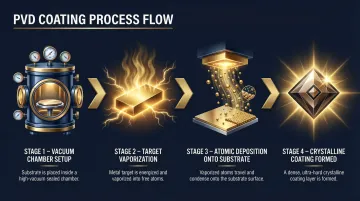
PVD (Physical Vapor Deposition) is a vacuum-based coating process where a solid metal target—such as titanium nitride, zirconium nitride, or gold—is vaporized and deposited as an ultra-thin, dense film onto a substrate surface. The coating bonds at an atomic level, creating a finish significantly harder and more adherent than electroplated alternatives.
The process takes place inside a vacuum chamber: the target material is either sputtered using magnetron technology or thermally evaporated, then condenses onto the part's surface at elevated temperatures. This forms a crystalline structure that resists wear, tarnish, and corrosion.
Key Performance Benefits:
- Achieves Vickers hardness values 3-5 times higher than electroplated gold
- Resists oxidation and environmental degradation through molecular-level bonding
- Complies with RoHS regulations without additional post-coating treatment
- Produces gold, rose gold, black, chrome, and custom colors from a single vacuum process
Process Limitations:
- Line-of-sight deposition makes it difficult to coat recessed areas or complex internal shapes
- Requires vacuum equipment investment, making it cost-prohibitive at very low volumes
- Substrates must tolerate process temperatures (typically 150–500°C depending on coating type)
- Not compatible with all base materials—soft metals and certain plastics may not be suitable
Use Cases of PVD Coating
Where durability and appearance must hold up under daily mechanical wear, PVD is the go-to choice. Common applications include luxury watches, eyewear frames, writing instruments, cosmetic compact closures, plumbing fixtures, medical surgical instruments, automotive trim, and architectural hardware.
A specific industrial example: cosmetic packaging for prestige beauty brands requires gold finishes that maintain flawless appearance through months of retail display and daily consumer handling. Providence Metallizing Company pioneered magnetron sputtering for titanium nitride and zirconium nitride coatings in the 1980s, then adapted the technology for cosmetic packaging. Today, their high-volume PVD operation processes over one million parts weekly for brands including Estée Lauder and Elizabeth Arden—maintaining jewelry-quality consistency at production scale.
Research from Advanced Plating Technologies confirms that PVD-coated connectors outlast standard 30 µin gold-plated connectors by 2–3x in high-cycle testing.
What Is Gold Plating?
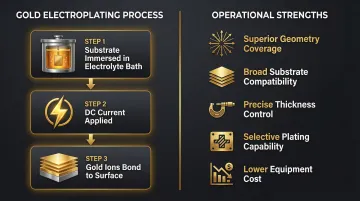
Gold plating (electroplating) is a wet electrochemical process where a workpiece is immersed in an electrolyte solution containing dissolved gold ions. A low-voltage DC current causes gold ions to migrate and bond onto the substrate surface. This method has served as the industry standard for decades due to its precision, versatility, and proven reliability across electronics, medical devices, and decorative finishing applications.
Technical Variants
- Hard gold (Type II per ASTM B488): Gold alloyed with cobalt or nickel, achieving Knoop hardness of 130–200+ HK25 — the go-to for electronic connectors and high-cycle contacts
- Soft/pure gold (Type I or III): Minimum 99.7% purity for wire bonding, semiconductor applications, and medical devices requiring maximum biocompatibility
- Decorative gold: Various karat specifications (14K, 18K, 24K) for jewelry, cosmetic hardware, and luxury packaging where aesthetics drive the spec
Thickness specifications range from flash plating (0.25 µm) for solderability to heavy build-up (5.0+ µm) for wear-critical applications, with ASTM B488 and MIL-DTL-45204D providing standardized classification systems.
Operational Strengths
- Superior geometry coverage: Electrochemical deposition reaches recessed areas, internal cavities, and complex contours uniformly
- Wide substrate compatibility: Plates to brass, copper, zinc alloys, aluminum, stainless steel, and plastics (with proper pre-treatment)
- Precise thickness control: Deposit thickness adjustable from sub-micron flash to multi-micron heavy coatings via current density and plating time
- Selective plating capability: Masking enables partial coverage for functional or aesthetic requirements
- Lower equipment entry cost: Standard rectifiers and tanks cost far less than comparable vacuum PVD chambers
Limitations
- Thinner deposits (below 1.0 µm) wear off relatively quickly under mechanical stress or chemical exposure
- Process involves chemical baths requiring environmental management and waste treatment
- Gold material cost makes heavy deposits expensive for large parts or high volumes
- Adhesion failures can occur without rigorous surface preparation and nickel underplating
Use Cases of Gold Plating
Gold plating dominates wherever electrical conductivity, biocompatibility, or complex geometry coverage is non-negotiable:
- PCB connectors and contacts
- Medical implants and surgical instruments
- Aerospace components
- Costume jewelry
- Cosmetic packaging requiring matched finishes across metal and plastic components
In electronics, 30 µin (0.76 µm) gold over nickel has become the telecommunications connector standard per ASTM B488 and Samtec specifications. That deposit withstands 300–500+ mating cycles while passing Mixed Flowing Gas environmental testing — a performance threshold few alternative finishes can match.
Cosmetic packaging presents a different challenge: brand consistency demands identical gold finishes across metal caps and plastic pumps in the same product line. Providence Metallizing Company uses electroplating's substrate flexibility to achieve exactly that match. The company's approved supplier status with Estée Lauder, L'Oreal, Avon, and Elizabeth Arden reflects the confidence prestige brands place in electroplated finishes for luxury packaging.
According to the World Gold Council, electronics sector gold demand increased in Q1 2024, driven by AI-related infrastructure growth, a trend that underscores why electroplating remains the preferred choice for high-tech manufacturing.
PVD Coating vs. Gold Plating: Which Is Better for Your Application?
The right choice comes down to six factors specific to your application:
- Surface hardness and wear resistance requirements
- Substrate material
- Part geometry complexity
- Production volume
- Environmental compliance requirements
- Total lifecycle cost
Durability Head-to-Head
PVD coatings achieve significantly higher surface hardness than electroplated gold. Titanium nitride and zirconium nitride typically rate 2,000–3,000 Vickers hardness, compared to 90–200 Knoop hardness for electroplated hard gold per ASTM B488 standards. That gap translates directly to longer service life under scratching, abrasion, and daily handling.
| Finish | Hardness Range | Primary Wear Advantage |
|---|---|---|
| PVD (TiN/ZrN) | 2,000–3,000 HV | Scratch and abrasion resistance |
| Electroplated Hard Gold | 90–200 HK (ASTM B488) | Controlled thickness, ductility |
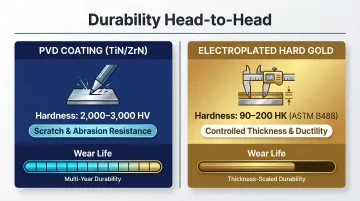
Gold plating durability scales with thickness. Standard 10–15 µin deposits wear quickly under regular handling. Heavy gold deposits of 2.5+ µm can approach PVD performance for moderate-wear applications, though at higher material cost.
For electronic connectors, industry data from EDAC shows that 30 µin gold plating supports 300–500 mating cycles on machined contacts, while 50 µin deposits extend this to 750+ cycles—demonstrating that thicker electroplated deposits can meet demanding mechanical requirements.
Situational Recommendations
Choose PVD coating if:
- Application involves daily mechanical wear (cosmetic packaging, plumbing hardware, architectural trim)
- Substrate is stainless steel, titanium, or hardened metal
- Environmental compliance and RoHS requirements are priorities
- Color consistency and multi-year lifecycle are non-negotiable
- Production volume justifies vacuum equipment investment (typically 10,000+ parts annually)
Choose gold plating if:
- Part geometry includes deep recesses, internal cavities, or complex contours
- Substrate is brass, copper, zinc alloy, aluminum, or engineering-grade plastic
- Selective or masked plating is required for partial coverage
- Electrical conductivity is a functional requirement (connectors, contacts)
- Project budget favors lower upfront processing costs
- Biocompatibility certification is required (medical devices per ISO 10993-1)
The Hybrid Scenario
Finishers with both PVD and electroplating capabilities—like Providence Metallizing Company—can match the process to each component rather than forcing a single solution across an assembly. Wear-critical metal parts may receive PVD; complex plastic components may be electroplated. Both finishes are then matched to achieve visual consistency across the final product.
Real-World Applications and Case Studies
The cosmetic packaging industry provides a high-stakes testing ground where both processes are rigorously evaluated. Prestige beauty brands require gold finishes that appear identical across metal caps, plastic pumps, and glass bottles—with zero fading at retail or in consumer hands over product lifecycles exceeding 18 months.
Providence Metallizing Company's experience as an approved supplier for Estée Lauder, L'Oreal, Avon, and Elizabeth Arden demonstrates the quality standards both processes can achieve when properly executed. A notable example: the 2011 Viva La Juicy Limited Edition bottle for Elizabeth Arden, which received industry recognition as Finish of the Year.
The Challenge:
Create a distinctive antique gold "crackle" finish on glass with random crystalline growth patterns—ensuring no two bottles looked identical while maintaining superior adhesion, fragrance resistance, and scratch resistance for cast logo application.
The Process Selected:
Vacuum metallizing (PVD) with custom masking to create crisp but random delineation across the glass surface.
The Outcome:
Elizabeth Arden's testimonial captured the commercial success: "We had been worried about the finish and considered various methods before deciding to go with PMC. In the end we only made one mistake: we didn't order enough pieces because the item sold out in less than a month!"

The right finish depends on matching process capabilities to specific product requirements: durability demands, substrate constraints, aesthetic vision, and production volume. A finishing partner experienced in both PVD and electroplating can assess those requirements upfront, saving significant time and cost before production begins.
Providence Metallizing Company offers free sampling for most applications — a practical first step for evaluating which process suits your specific substrate and finish requirements. Reach out at 401-722-5300 or inquiries@providencemetallizing.com to request a sample or quote.
Conclusion
PVD coating excels in high-wear, high-consistency applications where long-term durability, environmental compliance, and aesthetic permanence matter most. Gold plating offers proven flexibility for complex geometries, wider substrate compatibility, precise functional performance in electronics and medical devices, and cost-effective coverage for moderate-volume production.
For manufacturers and product designers, this choice directly impacts finishing cost, product lifecycle, brand perception, and regulatory compliance. The right decision comes down to evaluating:
- Substrate material and whether it accepts PVD or electroplating adhesion
- Part geometry and whether racking or masking is feasible at your production volume
- Wear environment and how much abrasion, corrosion, or chemical exposure the finish must survive
- Production volume and whether per-part cost favors batch electroplating or continuous PVD runs
- Budget across both upfront tooling and long-term lifecycle costs
From there, the process is straightforward: partner with a finishing provider experienced in both methods who can run samples and confirm which process delivers your target spec.
Whether you need million-part-per-week PVD capacity for luxury cosmetics or precision electroplated connectors for medical devices, the finish process and the finishing partner you choose will determine whether the final product holds up in the field — and on the shelf.
Frequently Asked Questions
Does PVD last longer than gold plating?
Yes, PVD coatings generally outlast gold plating by years under daily wear conditions due to their molecular-level bond and higher surface hardness. However, heavy gold plating (2.5+ µm thick deposits) can narrow this durability gap for moderate-use applications.
How long does 18k gold PVD coating last?
18k gold PVD coatings typically last several years with regular wear when properly maintained, outlasting standard gold plating under identical conditions. The finish is hard and tarnish-resistant, holding up well through routine daily use.
Is gold plating or PVD better?
Neither is universally better. PVD delivers superior durability and wear resistance for high-cycle applications, while gold plating offers greater flexibility in substrate compatibility, complex geometry coverage, and lower upfront processing costs. The right choice depends on your specific application requirements.
Is PVD gold plating real gold?
Yes, PVD gold coating uses real gold (or gold alloy) as the target material, depositing gold particles onto the surface. However, the deposited layer is extremely thin (typically sub-micron), and the base material is usually stainless steel or titanium—so the part is not solid gold.
Is 18k gold PVD plating good?
Yes, 18k gold PVD is a premium finish with rich color and strong wear resistance. It's well-suited for jewelry, cosmetic hardware, and luxury packaging where appearance needs to hold up under regular handling.
What is 18k gold vacuum plating?
18k gold vacuum plating is another term for PVD coating using 18-karat gold as the source material. The vacuum environment enables precise deposition of gold particles, producing a durable, consistent finish.