Introduction
Physical vapor deposition (PVD) has become a go-to coating technology across industries. Cosmetic packaging, jewelry, automotive components, and surgical instruments all rely on it for the same core reasons.
Manufacturers choose PVD over traditional electroplating and painting because it delivers exceptional hardness, precise thickness control, and metallic finishes that hold up against wear and corrosion.
PVD coating cost isn't a fixed number you can pull from a price list. It varies based on part size and complexity, coating material, batch volume, substrate type, and whether you're coating in-house or outsourcing to a service provider. This guide breaks down realistic pricing ranges, the key cost drivers, and how to approach budgeting for PVD finishing.
Key Takeaways
- PVD coating costs range from fractions of a cent per part (high-volume in-house) to $50+ per part (outsourced specialty coatings like DLC)
- Top cost drivers: coating material, part geometry, batch quantity, and substrate preparation requirements
- High-volume decorative applications produce the lowest per-part costs
- Functional, industrial, and specialty coatings (such as DLC or CrN) typically cost two to five times more
- Outsourcing makes financial sense for low-to-mid volumes or specialized needs
- In-house equipment investment becomes viable above roughly $100,000 in annual coating spend
How Much Does PVD Coating Cost?
PVD coating has no standard price list. Quoting requires knowing your part specifics—and misunderstanding this leads to underbudgeting, choosing the wrong coating for the application, or being surprised by setup fees and minimum batch charges.
Most buyers encounter two pricing models: per-part pricing for outsourced coating services, and per-batch pricing when evaluating in-house equipment. For outsourced services (the focus here), most providers charge minimum lot fees of $100–$150, though some industrial shops set minimums as high as $875.
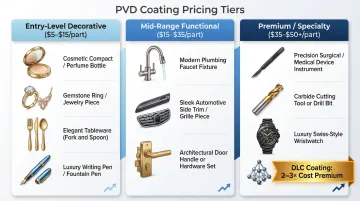
Entry-Level / High-Volume Decorative PVD
Standard TiN, ZrN, or CrN coatings in common colors—gold, rose gold, silver, black—on simple to moderate geometry parts. High-volume batches with minimal pre-treatment keep costs low.
Typical cost: $5–$15 per part. At scale production, costs can drop to $0.34 per pen or $0.27 per square inch.
Common applications include:
- Cosmetic and personal care packaging
- Jewelry and accessories
- Writing instruments and tableware
- Small hardware components requiring consistent decorative finish
Mid-Range / Functional or Complex Decorative PVD
This tier covers parts that need more than looks—plumbing fixtures, automotive trim, architectural hardware, and industrial components requiring moderate wear or corrosion resistance. More complex geometries, custom color matching, or base coat requirements push costs into this range.
Typical cost: $15–$35 per part.
Well-suited for plumbing and hardware manufacturers, automotive suppliers, and architectural finishing projects where durability and appearance both matter.
Premium / Specialty PVD (DLC, Multi-Layer, High-Specification)
Diamond-like carbon (DLC) coatings, multi-layer stacks, and coatings on engineering-grade substrates fall here. Medical implants, cutting tools, and aerospace components typically require tight thickness tolerances and extended processing cycles that drive up cost.
Typical cost: $35–$50+ per part. High-end consumer applications—watch cases, firearm slides—can add $100–$500+ to the final component price.
DLC runs 2–3 times more than standard nitrides because of expensive target materials and complex deposition processes. This tier is the right call when extreme hardness, low friction, or biocompatibility aren't optional:
- Medical device manufacturers
- Cutting tool producers
- Luxury watch and high-end firearms brands
- Aerospace and defense components
Key Factors That Affect PVD Coating Cost
Pricing is determined by a combination of technical specifications and operational variables. Getting an accurate quote requires understanding how each of these factors applies to your specific part.
Coating Type and Target Material
Different PVD materials carry different costs and process requirements:
- Titanium nitride (TiN) — Standard decorative gold coating, baseline cost
- Zirconium nitride (ZrN) — High-performance gold alternative, moderate premium
- Chromium nitride (CrN) — Corrosion-resistant, moderate premium
- Diamond-like carbon (DLC) — 2–3× more expensive than standard nitrides
Target material waste is a cost factor that often surprises buyers: traditional magnetron sputtering achieves only 20–30% target utilization, meaning up to 80% of expensive material never reaches the part. Reactive gases (nitrogen, argon, methane) used during deposition add further to per-batch consumable costs, and industrial gas prices fluctuate with market conditions.
Part Size, Shape, and Geometric Complexity
Larger parts require more rack space per batch, reducing parts per run and increasing cost per part. Complex three-dimensional geometries are harder to coat uniformly. Because PVD is a line-of-sight process, intricate shapes often require:
- Custom fixturing or multi-axis planetary rotation
- Multiple orientations to ensure complete coverage
- Reduced chamber density (fewer parts per batch)
For highly complex geometries, these requirements can push per-part costs 50% higher than simple flat or cylindrical parts.
Batch Volume and Order Quantity
Batch volume drives per-part cost more than almost any other variable. Setup, chamber pumpdown, and gas purging are fixed costs per batch regardless of how many parts are loaded — coating 200 parts costs far less per part than coating 20.
Key consideration: Most service providers have minimum order quantities. Ask how pricing changes at different volume tiers:
- 50 parts vs. 500 parts
- 1,000 parts vs. 10,000 parts
- Annual contract volume vs. spot orders
Consolidating runs to maximize chamber density can drop per-part pricing by up to 40%.
Substrate Material and Required Pre-Treatment
Some substrate materials require a base coat — typically a nickel, chromium, or adhesion-promoting layer applied before PVD deposition. This adds both process steps and cost.
How much pre-treatment your substrate needs depends on the material:
- Stainless steel — Generally ideal for PVD, but the passive chromium oxide layer must be removed via sputter etching or chemical passivation before deposition
- Plastics (e.g., polycarbonate) — Require specialized plasma treatment to promote adhesion without weakening the substrate
- Materials requiring base coats — Can add $20–$100+ per part compared to substrates that coat directly
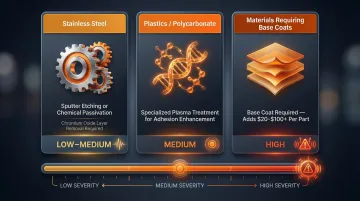
Skipping or shortcutting pre-treatment is a common source of adhesion failures — and the rework cost almost always exceeds what proper prep would have added upfront.
Coating Specifications and Performance Requirements
Tighter tolerances increase processing time and material complexity:
| Specification | Impact on Cost |
|---|---|
| Coating thickness tolerance | ±0.1 micron vs. ±0.5 micron requires more process control |
| Hardness targets | Higher hardness (3000+ HV) requires longer deposition cycles |
| Corrosion resistance | Enhanced performance needs specific material combinations |
| Custom color matching | Requires trial runs and process optimization |
A decorative TiN finish on a cosmetic cap and a hard-wear CrAlN coating on a precision mold may look similar on a quote request — but the process complexity, cycle time, and material cost differ substantially.
What Goes Into the Total Cost: Beyond the Per-Part Price
A per-part quote from a PVD service provider typically covers deposition only — not the full scope of work. Knowing what's billed separately upfront helps you build an accurate project budget.
Commonly Included in Quotes:
- Coating application
- Basic cleaning and pre-treatment
- Standard certification documentation
Commonly Excluded (Billed Separately):
- Pre-coating surface finishing (polishing, grinding)
- Masking for selective coating (difficult and imperfect in PVD)
- Custom fixturing and tooling design
- Incoming and outgoing freight
- Advanced metallurgical testing
- Minimum lot charges ($100–$150 typical)
Recurring Cost Components in Outsourced PVD
Beyond the initial quote, these costs accumulate over time:
- Each design variation or new color may trigger setup charges — budget for these when prototyping multiple options
- PVD coatings can't be touched up in place; restoration requires a full chemical strip and recoat, adding roughly 40% to the base coating price
- Regulated industries (medical, automotive) often require documentation that carries a 10–20% cost premium on top of standard pricing
Outsourced vs. In-House: Where the Cost Equation Shifts
For most manufacturers, outsourcing PVD work remains the lower-risk path — especially when annual volumes don't justify dedicated equipment, trained operators, or facility upgrades. The per-part price from a contract coater already absorbs those infrastructure costs.
Where outsourcing makes the most financial sense:
- Low-to-mid volumes where capital equipment can't be amortized efficiently
- Multiple finish types requiring different process setups — variety is cheaper to outsource than to replicate in-house
- Tight lead times where a high-capacity service provider can turn work faster than an internal queue
- Regulated applications (medical, automotive) where a certified provider handles compliance documentation
For very high-volume, single-finish production runs, the math can shift toward in-house — but that decision involves significant capital, facility, and staffing commitments beyond the scope of a coating quote.
In-House PVD Equipment vs. Outsourced Coating Services
The core trade-off comes down to volume and commitment. Outsourcing offers low upfront investment, specialized expertise, and flexibility for variable volumes. In-house equipment delivers lower per-part costs at sustained high volumes, but requires significant capital, operational know-how, and ongoing maintenance.
When Outsourcing Makes Financial Sense
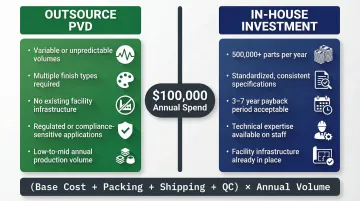
Outsourcing is typically optimal when:
- Annual coating spend is below $100,000
- Part types or coating specifications are highly variable
- You need rapid sampling and prototyping capability
- Coating is not a core competency for your business
- You lack facility infrastructure for PVD equipment
- Volume fluctuates significantly between quarters
Established service providers with high-volume infrastructure deliver consistent quality at competitive per-part rates. At that scale — facilities running over a million parts per week — outsourced providers spread fixed overhead across far more volume than any single manufacturer could justify internally. The per-part economics are hard to beat below a certain threshold.
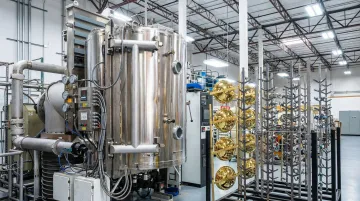
When In-House Investment Becomes Viable
The general threshold: manufacturers spending more than $100,000 annually on PVD outsourcing (typically 20,000–30,000 units) are prime candidates for in-house systems.
In-house operations are economically optimal when:
- Coating volume consistently exceeds 500,000 components per year per line
- Part and coating specifications are standardized
- Payback period of 3–7 years is acceptable for capital investment
- You have technical expertise to operate and maintain equipment
- Facility infrastructure supports vacuum deposition systems
To determine which side of that threshold you fall on, calculate your true outsourcing cost:
Total annual outsourcing cost = (Base coating cost per unit + packing/unpacking + shipping to/from supplier + QC inspection per unit) × annual volume
If that number clears $100,000, in-house investment warrants a serious look.
How to Budget for PVD Coating and Get an Accurate Quote
Information to Prepare Before Contacting a PVD Service Provider
Accurate quotes require detailed specifications:
Part specifications:
- Part dimensions and geometry (drawings or samples)
- Substrate material and composition
- Weight and wall thickness
- Complexity (flat, simple 3D, intricate geometry)
Coating requirements:
- Desired coating type (TiN, ZrN, CrN, DLC)
- Color or finish appearance (gold, black, brushed, etc.)
- Target performance specifications (hardness, corrosion resistance, friction coefficient)
- Coating thickness requirements and tolerances
- Areas requiring masking or selective coating
Volume and timing:
- Annual or project volume (parts per year)
- Order frequency (weekly, monthly, quarterly)
- Turnaround time requirements
- Regulatory or certification requirements (medical, automotive, aerospace)
How to Evaluate Quotes Beyond Unit Price
Don't select a provider on per-part price alone. Look for:
Process capability indicators:
- Equipment size and type (batch chamber dimensions, automation level)
- Quality certifications (ISO, industry-specific approvals)
- Industry experience and customer references
- Years in business and technical expertise
Service quality factors:
- Turnaround time from sampling to production
- Sampling policy (free samples for validation?)
- Ability to match finishes across different substrate materials
- Minimum order quantities and flexibility
- Technical support and process optimization assistance
Providence Metallizing Company offers free sampling for most applications, so buyers can validate finish quality and compatibility before committing to full production. With over 60 years of finishing experience and production capacity exceeding one million parts per week, PMC is an approved supplier to Estée Lauder, L'Oréal, Avon, and Elizabeth Arden — a track record that reflects consistent quality at scale.
To discuss your PVD coating requirements or request a free sample, contact Providence Metallizing at 401-722-5300 or email inquiries@providencemetallizing.com.
Frequently Asked Questions
How much does PVD coating cost?
PVD coating cost varies widely: from fractions of a cent per part for high-volume decorative applications run in-house to $50+ per part for outsourced specialty or low-volume work. The best way to get an accurate figure is to request a quote with part specifications, substrate material, desired coating type, and volume details.
How much does DLC coating cost?
Diamond-like carbon (DLC) coatings are among the more expensive PVD variants due to specialized processes and materials. DLC typically costs $35–$50+ per part for outsourced services—2 to 3 times more than standard TiN or ZrN coatings. High-end consumer applications like watch cases can add $100–$500+ to final component cost.
How much does chemical vapor deposition cost?
CVD (chemical vapor deposition) is a related but distinct process from PVD, used for different applications and substrates. It relies on vaporized chemicals reacting at high temperatures (up to 900°C) rather than physical vapor condensation. CVD pricing varies by part size, coating type, and volume but isn't directly comparable to PVD due to fundamentally different process requirements.
Is PVD coating good for stainless steel?
Yes, PVD bonds exceptionally well to stainless steel and is widely used to add decorative finishes (gold, black, rose gold) and enhanced corrosion or wear resistance to stainless components. Stainless steel often requires minimal pre-treatment compared to other substrates—though the passive chromium oxide layer must be removed via sputter etching for optimal adhesion—which can reduce overall coating cost.
Is PVD better than powder coating?
PVD and powder coating serve different purposes. PVD produces ultra-thin (0.5–5 microns), extremely hard (1500–4000 HV) coatings with superior durability and metallic finishes. Powder coating creates thick (25–125 microns) polymer shells better suited for large structural parts requiring impact resistance at lower cost. For decorative metallic finishes on precision parts where dimensional tolerances matter, PVD typically offers superior long-term performance.
Can you restore PVD coating?
PVD coatings cannot be touched up in place. Restoration requires stripping the existing layer chemically, re-polishing the substrate, and reapplying a full new coating. Stripping adds approximately 40% to base coating cost, which is why the right specification and substrate preparation upfront directly determines total lifecycle cost.