What is glass bead abrasive?
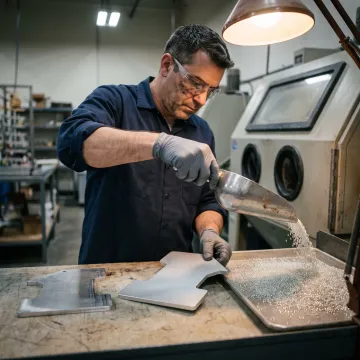
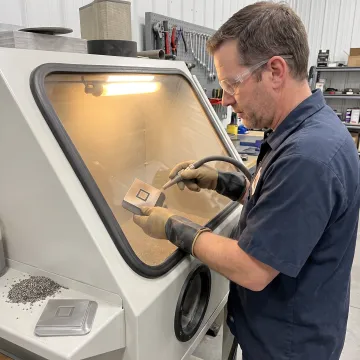
Glass bead abrasive is a spherical blasting media made from engineered soda-lime glass, designed for surface finishing and cleaning metal components. Unlike angular abrasives that cut or etch, glass beads create uniform satin finishes, remove surface contaminants without dimensional change, and impart compressive stress for improved fatigue resistance. Available in various sizes and hardness grades, glass beads are ideal for aluminum, steel, brass, and zinc die cast parts requiring repeatable surface textures, pre-plating preparation, or decorative finishing in high-volume production environments.
Can you glass bead blast aluminum?
Yes, glass bead blasting is exceptionally well-suited for aluminum finishing. Glass beads create uniform satin or matte finishes on aluminum without embedding in the softer metal, unlike steel or ceramic media. The process effectively removes oxidation, prepares surfaces for anodizing or plating, and can impart beneficial peening effects to improve fatigue strength. Our facility processes aluminum components ranging from aerospace parts to cosmetic closures, using precisely controlled bead sizes and pressures to achieve consistent results across millions of parts annually while maintaining tight dimensional tolerances.
What is bead blast finish?
A bead blast finish is a uniform, non-directional surface texture created by impacting metal with spherical glass beads at controlled velocities. The result is an elegant satin or matte appearance with consistent light diffusion properties, hiding minor surface imperfections while maintaining dimensional accuracy. Bead blast finishes are prized in cosmetic, architectural, and automotive applications for their jewelry-quality appearance and excellent adhesion base for subsequent plating, metallizing, or coating. Our automated systems deliver repeatable bead blast finishes on components from miniature closures to large lamp housings with exceptional consistency.
How does glass bead media compare to other abrasive types?
Glass beads offer distinct advantages over angular abrasives like aluminum oxide or silicon carbide. Their spherical shape produces satin finishes rather than aggressive etching, maintains tight tolerances without material removal, and won't embed in softer metals like aluminum or brass. Compared to steel shot, glass beads are chemically inert and won't contaminate stainless steel or leave ferrous residue. They're reusable for multiple cycles, cost-effective for high-volume production, and produce consistent surface profiles ideal for decorative finishing and pre-plating preparation across diverse metal substrates in our 200,000+ sq.ft. facility.
What surface preparation is needed before glass bead blasting?
Effective glass bead finishing requires clean, dry metal surfaces free from heavy oils, greases, or thick scale. Our pre-treatment process includes precision degreasing and cleaning to ensure optimal bead impact and uniform finish results. For heavily oxidized or scaled parts, we may recommend preliminary descaling before glass bead processing. Critical features requiring protection—such as threaded holes, sealing surfaces, or tight-tolerance dimensions—are masked using custom fixtures designed in-house. Proper preparation ensures maximum process efficiency, consistent surface texture, and superior adhesion for subsequent electroplating, metallizing, or coating operations.
Can glass bead finishing be integrated with plating or coating?
Absolutely. Our integrated 200,000 sq.ft. facility combines glass bead finishing with electroplating, vacuum metallizing, UV coating, and PVD processes under one roof. Glass bead blasting creates ideal surface profiles for maximum coating adhesion—critical for chrome, nickel, gold plating, or aluminum metallizing on plastic and metal substrates. Parts move seamlessly between finishing stages without external handling, reducing turnaround time by half compared to multi-vendor approaches. This integration ensures consistent quality across the entire finishing sequence, from initial bead blasting through final topcoat, for cosmetic, automotive, and industrial applications.
What industries benefit most from glass bead metal finishing?
Glass bead finishing serves diverse sectors requiring precision surface preparation and decorative finishes. The cosmetic industry relies on our bead blasting for jewelry-quality satin finishes on caps, closures, and packaging components—we're approved suppliers to Estée Lauder, L'Oréal, and Avon. Automotive manufacturers use glass bead peening for fatigue resistance on critical components. Architectural hardware, lighting fixtures, plumbing components, and medical devices benefit from our uniform surface textures and pre-plating preparation. Electronics manufacturers specify glass bead cleaning for precision metal parts requiring controlled surface energy before coating or assembly.
What lead times and production volumes can you accommodate?
Our high-capacity facility processes over a million parts weekly with 24-5 operations, handling everything from prototype samples to trailer loads of production components. We've built our reputation on lightning-fast turnaround—moving projects from initial sampling to full-scale production in half the industry-standard lead times through in-house custom tooling design and streamlined processes. Free sampling services are available for most applications, typically completed within days. Production runs scale from hundreds to millions of parts with consistent quality, supported by automated handling systems and over 60 years of process optimization expertise.