Introduction
Gold prices hit $4,649 per troy ounce in April 2026, up 55% year-over-year—directly pushing 24K gold plating costs higher across industries from cosmetic packaging to electronics. For manufacturers and commercial buyers, that price movement makes accurate budgeting harder than ever. 24K electroplating delivers the richest yellow tone of any karat option, but it's also the softest and most expensive — and quotes can vary dramatically depending on factors most buyers don't immediately see.
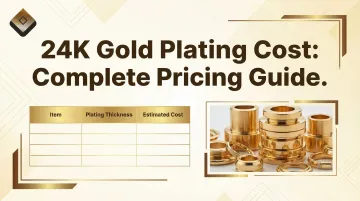
24K gold plating costs vary dramatically based on plating thickness (measured in microns), substrate material, part size, and order volume. A small jewelry component might cost under $30 for flash plating, while heavy commercial plating on architectural hardware can run $300 to $600+ per item. Commercial buyers typically see per-unit costs drop significantly on high-volume orders as setup fees spread across thousands of parts.
This guide covers real-world price ranges, the cost drivers unique to 24K plating, and what to look for in a quote — so you can budget accurately whether you're running a prototype or scaling to full production.
Key Takeaways
- 24K gold plating costs range from under $30 for small jewelry items to $600+ for large architectural pieces, with commercial volume pricing dropping significantly per unit
- Primary cost drivers: plating thickness (microns), substrate prep, part complexity, and batch size—not just gold price
- 24K gold (99.9% pure) delivers unmatched color richness but is softer than alloyed gold—thicker deposits are needed to achieve comparable durability
- Thicker plating costs more upfront but extends service life from months to years, lowering total cost of ownership
How Much Does 24K Gold Plating Cost?
24K gold plating does not carry a fixed price. Costs span a wide range depending on application, quantity, substrate, and service provider.
Many buyers underbudget by focusing only on the gold layer itself—overlooking surface prep, undercoat layers, and post-plating finishing that collectively represent 40–60% of the total quote. Choosing a thin flash layer to save money often backfires when it fails prematurely, requiring replating within months. Per-unit vs. per-job pricing structures also affect commercial orders very differently from one-off items, making direct price comparisons misleading without understanding what each quote includes.
Typical Cost Range
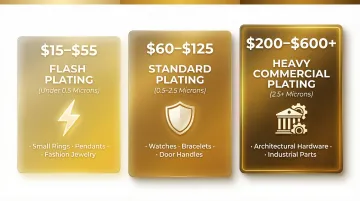
Entry-level / single small item (flash plating):
Small rings, pendants, or charms with thin flash plating (under 0.5 microns) typically cost $15 to $55. At this tier, labor and handling dominate the price since minimal gold is deposited.
Mid-range / standard professional plating:
Watches, bracelets, door handles, and flatware requiring standard thickness (0.5–2.5 microns) run $60 to $125. Costs increase due to larger surface area, thicker gold deposits, and required polishing/prep work.
High-end / heavy commercial plating:
Large architectural hardware, kitchen fixtures, and complex industrial parts with heavy plating (2.5+ microns) cost $200 to $600+. These jobs consume significant gold, require complex racking and masking, and demand precision quality control.
What's Included (and What Isn't)
Most quotes include cleaning, surface prep, plating bath processing, and basic finishing. However, several line items are often billed separately:
- Repair of damaged surfaces or removal of previous coatings
- Rush turnaround fees (expedited processing)
- Custom tooling or masking for selective plating areas
- Post-plating protective topcoats or specialized polishing
Consumer / Retail Applications
Includes: Degreasing, flash or standard 24K plating (0.5–2 microns), basic polishing
Best For: Individuals replating heirloom jewelry, fashion accessories, watches, or personal decorative items
Industrial / Commercial Applications
Includes: Substrate preparation, adhesion primer layers (nickel or copper undercoat), specified-thickness 24K plating to ASTM B488 standards, thickness verification, quality inspection
Best For: Brands and manufacturers requiring consistent, high-volume, spec-controlled plating across production runs—particularly cosmetic packaging, electronic components, and architectural hardware
Providence Metallizing Company serves as an approved supplier to Estée Lauder, L'Oreal, Avon, and Elizabeth Arden, specializing in European Quality 24K gold plating on injection-molded plastic for prestige cosmetic packaging.
Volume / Batch Pricing
Beyond application type, order quantity is one of the biggest levers on final cost. Per-unit pricing drops sharply at scale, with setup and tooling costs spread across the batch rather than charged to individual pieces.
Best For: Manufacturers, cosmetic brands, and OEM suppliers producing thousands of parts per run
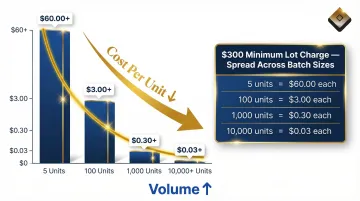
Most plating shops enforce minimum lot charges of $150 to $300 to cover setup, bath preparation, and administrative overhead. At commercial scale (10,000+ units), per-unit costs can drop to pennies for thin plating, while spreading a $300 minimum over just 5 units adds $60 per part.
Key Factors That Affect the Cost of 24K Gold Plating
Pricing depends on a combination of material, process, scale, and specification factors. Understanding each helps you avoid surprises when quotes arrive.
Plating Thickness (Microns)
The three main tiers directly multiply both gold material cost and processing time:
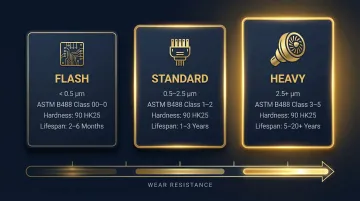
Flash plating (under 0.5 microns):
Decorative applications, budget fashion jewelry, static electrical connections. ASTM B488 Class 00 to Class 0 (0.1–0.5 µm). Wears through in 2–6 months under regular use.
Standard plating (0.5–2.5 microns):
General electrical contacts, premium fashion jewelry, moderate wear items. ASTM B488 Class 1 to Class 2 (0.5–2.5 µm). Lifespan of 1–3 years for jewelry, up to 10 years for static connectors.
Heavy plating (2.5+ microns):
High-reliability aerospace/military components, vermeil jewelry, harsh environments. ASTM B488 Class 3 to Class 5 (2.5–5.0 µm). Expected lifespan 5–10+ years for luxury accessories, 10–20+ years for industrial connectors.
Critical consideration for 24K gold: Pure 24K gold (ASTM B488 Type III, 99.9% purity) is inherently soft, with a Knoop hardness of just 90 HK25 maximum. That's well below hard gold alloys (130–200 HK25). This means 24K requires thicker deposits to achieve comparable wear resistance, making thickness selection more critical than with lower-karat alternatives.
Material consumption scales linearly: Using gold's density of 19.32 g/cm³, 1 micron of plating consumes approximately 0.001932 grams per square centimeter. At $4,649/oz ($149.49/gram), even small thickness increases add measurable material cost at scale.
Substrate Material and Surface Preparation
Base metal determines process complexity and total cost:
Copper and brass:
Standard substrates that accept plating readily, but require a nickel diffusion barrier to prevent copper/zinc migration into the gold layer (which causes tarnish and discoloration).
Stainless steel:
Requires specialized activation using a Wood's Nickel Strike (highly acidic nickel chloride solution) to remove passive oxide layers before gold will adhere.
Aluminum:
Demands complex multi-step pretreatment, typically a zincate immersion process followed by copper or nickel strike layers, before gold application can begin.
Plastics (ABS, PC, Ultem, Nylon):
Plating on plastics (POP) is highly complex. It requires chromic acid etching, palladium/tin salt activation, and electroless nickel or copper layers to make the surface conductive before electroplating. Electroless nickel alone adds $7 to $20 per square foot.
Surface condition matters: Damaged, corroded, or heavily worn surfaces require extensive prep work — polishing, buffing, defect repair — representing significant labor cost often underestimated by buyers. Low-cost providers frequently cut corners here, leading to poor adhesion and premature failure.
Engineering-grade plastics like Ultem, Nylon, and LCP require particularly specialized pretreatment sequences that most general plating shops aren't equipped to handle reliably.
Item Size, Geometry, and Complexity
Surface area directly determines gold consumption, while complex geometries multiply processing time:
- Recessed areas and fine detail work require slower plating rates and skilled masking
- Irregular shapes demand custom racking and selective plating techniques
- Large surface areas (bathroom fixtures, architectural panels) consume substantially more gold even at identical thickness
Gold Purity and Current Gold Market Price
24K plating uses essentially pure gold (99.9%), carrying higher material cost than 18K or 14K solutions. With spot prices exceeding $4,649 per troy ounce in April 2026 (a 55% year-over-year increase), material costs have become the dominant line item for heavy plating applications.
Even small micron differences translate to real cost at scale — plating 10,000 connector pins at 1.0 micron versus 1.5 microns can shift material cost by thousands of dollars. Professional providers must also account for cathode current efficiency (typically ~90% for gold cyanide baths) and drag-out losses, which together increase actual gold consumption by up to 20% over theoretical calculations.
Volume and Production Scale
Commercial plating is priced per-unit with costs decreasing sharply at volume:
- Fixed setup costs (tooling, bath preparation, masking) spread across batch size
- Selective plating on industrial parts (targeting only functional contact areas) reduces gold consumption by 30–70% versus full-part plating
- Amortization impact: A $300 minimum lot charge adds only $0.30 per part across 1,000 units, but $60 per part across just 5 units
High-volume finishing operations running over a million parts per week — like Providence Metallizing — can spread setup costs across large batches, which directly lowers per-unit gold plating costs for production buyers.
What You're Really Paying For: The 24K Gold Plating Cost Breakdown
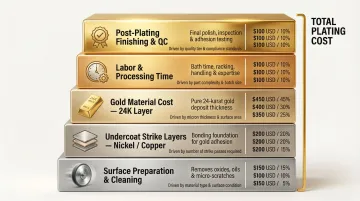
The total cost is made up of several components beyond just the gold itself. Understanding the breakdown helps buyers evaluate quotes accurately and avoid comparing prices that aren't structured the same way.
Surface Preparation and Cleaning
Surface prep covers degreasing, polishing, and repair of surface defects — and it's billed once per job. For worn or damaged items, prep can represent a significant share of the total quote. Low-cost providers often skip steps here, which leads to poor adhesion and premature plating failure.
Undercoat / Strike Layers (Nickel, Copper)
Professional 24K plating on most substrates requires one or more adhesion-promoting base layers, billed per job (sometimes itemized, sometimes bundled). Nickel is the most common choice — it acts as a diffusion barrier against base metal migration, provides a load-bearing foundation, and levels the surface for a brighter finish.
For clients distributing into EU markets, EU REACH Annex XVII restricts nickel release to 0.5 µg/cm²/week for jewelry and skin-contact items. This drives adoption of palladium or white bronze strike layers, which add cost but ensure regulatory compliance for global distribution.
Gold Material Cost (the 24K layer itself)
The actual gold deposited is billed per job and scales directly with thickness and surface area. At commercial scale, consumption is calculated by troy ounce per batch:
Surface Area (cm²) × Thickness (cm) × Gold Density (19.32 g/cm³) = Grams Required Then multiplied by current spot price (~$149.49/gram).
For a 10 cm² connector requiring 2.0 microns of 24K gold:
10 × 0.0002 × 19.32 = 0.03864 grams × $149.49 = $5.78 in gold material alone (before efficiency losses).
Labor and Processing Time
Labor covers operator time, bath management, and quality inspection — billed per job and scaled to complexity. For small-batch or bespoke work, it's often the largest single line item. High-volume production reduces this cost significantly, which is why batch size matters when comparing quotes.
Factors that drive labor costs up include:
- Complex geometries requiring manual handling
- Fine detail work with tight masking requirements
- Parts that are difficult to rack or fixture consistently
Post-Plating Finishing and Quality Control
Post-plating finishing and QC are billed per job or on a periodic basis, depending on the application. These steps add cost but are non-negotiable for industries where uniform appearance across high-volume runs is required — cosmetic packaging and branded hardware being the clearest examples.
QC typically includes:
- Polishing and protective topcoat application
- Thickness verification via XRF analyzer (per ASTM B488 specifications)
- Adhesion testing to prevent downstream warranty failures
Flash, Standard, or Heavy 24K Plating — Which Is Worth the Price?
The plating thickness tier you choose has the single greatest impact on both price and performance. Here's how to think about which level makes sense for your application.
Performance Across Thickness Tiers
| Thickness Tier | Visual Appearance | Wear Resistance | Replating Frequency | Total Cost of Ownership |
|---|---|---|---|---|
| Flash (<0.5 µm) | Rich initially, fades quickly | Poor—wears through in months | Every 2-6 months | High due to frequent replating |
| Standard (0.5–2.5 µm) | Consistent color, moderate durability | Good for moderate wear | Every 1-3 years | Moderate—balances upfront and maintenance |
| Heavy (2.5+ µm) | Excellent long-term consistency | Excellent—5-10+ years | Rarely needed | Low—higher upfront, minimal maintenance |
The table makes the tradeoffs clear. What it can't show is which tier fits your specific use case — that depends on how the part will be used.
When Heavy 24K Plating Is the Clear Choice
- High-touch parts (rings, handles, architectural hardware): Soft 24K gold wears through quickly without adequate thickness, so frequent friction or contact demands the heavier tier.
- Consistent appearance across production runs: Prestige cosmetic packaging and branded product lines require finish uniformity over years of service — heavy plating is the only reliable way to hold that standard.
- Functional industrial applications: When corrosion resistance or electrical conductivity is part of the spec (not just decoration), thin plating on connectors or contact surfaces leads to field failures and warranty claims.
When Flash Plating Is Adequate
- Decorative accents that won't see daily contact
- Short-run samples and prototypes for visual evaluation
- Budget fashion jewelry with expected lifespan under one year
- Static display items in controlled environments
If you're unsure which tier fits your application, sampling before committing to a full run is worth building into your process. Providence Metallizing Company offers free sampling for most applications, covering specifications from thin decorative layers through precision industrial requirements including ASTM B488 Class 5 — so you can evaluate finish quality and durability on your actual parts before locking in an order.
How to Estimate and Budget for 24K Gold Plating
A realistic budget starts with a clear understanding of what the project actually requires—not just the gold layer, but everything the plating process involves.
Key Questions to Answer Before Requesting Quotes
Substrate material: ABS plastic, brass, stainless steel, aluminum? Each requires different prep work and undercoats, directly affecting cost.
Required plating thickness: What is the end-use durability requirement? Will parts see daily handling, occasional contact, or static display?
Batch size: Are you plating 5 pieces, 500, or 50,000? Volume drastically affects per-unit pricing due to setup cost amortization.
Surface condition: Are there defects, prior coatings, or corrosion that need addressing? Surface prep can represent 30–50% of total cost for worn items.
Quality inspection requirements: Do you need ASTM B488 specification compliance, thickness verification, adhesion testing, or regulatory documentation (such as REACH compliance for jewelry)?
Most Common Budgeting Mistakes
With those questions answered, you're ready to avoid the errors that inflate costs most often:
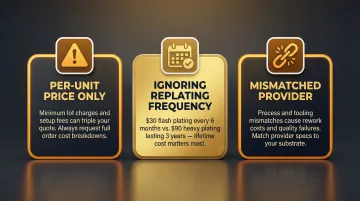
- Per-unit price alone doesn't tell the full story. A quote of "$2 per part" is meaningless without knowing the minimum lot charge and what surface prep is included.
- Replating frequency changes the math. A $30 flash plating redone every 6 months costs more over 3 years than a $90 heavy plating that holds for the full period.
- Mismatched providers create hidden costs. A cosmetic packaging shop and a jewelry plater have different processes, tooling, and quality systems — using the wrong one leads to higher costs and avoidable failures.
What Most Buyers Miss
Beyond the obvious line items, three factors consistently catch buyers off guard:
- Poor adhesion is expensive to fix. Plating that peels or flakes triggers warranty claims, customer complaints, and emergency replating at premium prices. Proper surface prep and undercoats are investments, not overhead.
- Substrate quality drives plating performance. Surface contamination, mold release residue, and porosity from poor-quality injection molding undermine gold adhesion regardless of plating thickness. Providers who flag substrate issues early prevent costly failures downstream.
- High-volume shops deliver lower per-unit cost. Shops processing millions of parts annually spread tooling and setup costs across larger runs, producing consistent quality at better pricing. Providence Metallizing runs over a million parts per week and operates on roughly half the lead times typical for sampling through production — a practical advantage when program timelines are tight.
Frequently Asked Questions
How much does 24K gold plating cost?
24K gold plating typically ranges from $15–$55 for small items with flash plating to $200–$600+ for large architectural hardware or complex industrial parts requiring heavy deposits. Commercial volume pricing drops significantly per unit as setup costs amortize across larger batches.
How much does it cost to get jewelry gold plated?
Professional jewelry gold plating costs vary by item type and thickness. Small rings or pendants typically run $15–$55 for flash plating, while watches and bracelets cost $60–$125. Heavy plating for heirloom pieces can reach $150+, with 24K commanding the highest price over 18K or 14K options.
How to calculate plating cost?
Plating cost is calculated based on surface area (cm²) × thickness (microns) × gold density (19.32 g/cm³) = grams of gold required, then multiplied by current spot price (~$149.49/gram at $4,649/oz). Add labor (racking, prep, quality assurance), overhead (electricity, bath maintenance), and any minimum lot charges. Most professional providers quote based on these inputs after reviewing your part specifications.
How long does 24K gold plating last?
Lifespan ranges from 2–6 months for flash plating (under 0.5 microns) to 5–10+ years for heavy plating (2.5+ microns), depending on wear environment. 24K's softness (90 HK25 hardness) makes thickness especially critical — a 1.0-micron deposit on a ring may wear through in under a year, while 3.0 microns on architectural hardware can last a decade.
Is gold plating worth the money?
Gold plating delivers the appearance and functional benefits (corrosion resistance, conductivity) of solid gold at a fraction of the cost, making it worthwhile when applied with the right thickness for the intended use. However, inadequate thickness or poor substrate prep leads to premature failure and replating costs that exceed the initial savings.
Can 24K gold be plated?
Yes, 24K gold plating is possible and commonly used for its rich color and purity (99.9% gold per ASTM B488 Type III). However, 24K is softer than lower-karat alloys (14K, 18K), with a hardness of only 90 HK25 versus 130–200 HK25 for hard gold. It is typically applied over a harder undercoat (nickel, palladium, or copper) to provide structural support and durability, especially for wear-prone applications.
Ready to discuss your 24K gold plating project? Providence Metallizing Company offers free sampling services and can move parts from sampling to production in half the normal lead times. Contact their team at 401-722-5300 or inquiries@providencemetallizing.com to request a quote tailored to your specifications.