Introduction
Manufacturers, product designers, and packaging engineers face a recurring decision: PVD or powder coating? Both are capable finishing processes, but they serve different purposes — and choosing the wrong one can compromise durability, aesthetics, and production costs.
The right choice depends on your specific application. A perfume cap needing a flawless gold metallic finish has completely different requirements than an outdoor aluminum railing built for weather resistance.
This guide breaks down the key differences across:
- Substrate compatibility (metals, plastics, glass)
- Finish appearance and decorative range
- Durability and environmental resistance
- Cost structure and production volume
Key Takeaways
- PVD deposits a thin metallic film (1–5 microns) in a vacuum chamber; powder coating applies a thicker polymer layer (50–150 microns) via electrostatic spray and heat curing
- Scratch resistance, corrosion protection, and premium metallic aesthetics favor PVD; broader color range and lower cost favor powder coating
- Best uses: PVD for cosmetics, medical devices, and precision hardware; powder coating for industrial, architectural, and outdoor applications
- PVD damage is permanent; powder coating can be touched up or recoated
- Key decision factors: substrate type, finish appearance, durability needs, production volume, and budget
PVD Coating vs Powder Coating: Quick Comparison
Here's how the two processes compare across the factors that matter most for your application.
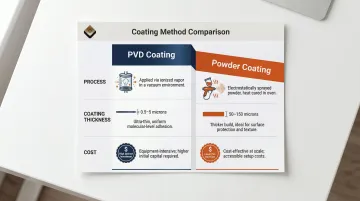
| Factor | PVD Coating | Powder Coating |
|---|---|---|
| Process | Material vaporized in a vacuum chamber and deposited atom-by-atom via magnetron sputtering or cathodic arc | Dry polymer powder electrostatically sprayed onto a grounded metal surface, then oven-cured at 150–200°C |
| Coating Thickness | 0.5–5 microns — molecularly bonded, no measurable bulk added | 50–150 microns — thicker polymer layer; can mask minor surface imperfections |
| Cost | Higher upfront investment; vacuum equipment runs $100,000–$1.5 million | Lower cost per unit for high-volume or large parts; material utilization reaches 95%+ with reclaim systems |
Durability & Scratch Resistance
PVD coatings are significantly harder than traditional surface treatments. Titanium Nitride reaches ~2,300 HV and Zirconium Nitride achieves 2,700–2,900 HV — well above hard chrome's 1,210 HV. The tradeoff: damage is permanent and cannot be spot-repaired.
Powder coating is durable and corrosion-resistant, with a softer surface than PVD. It has a practical advantage in repairability — scratches can be addressed through touch-up or full recoating.
Aesthetic Range
PVD produces brilliant, consistent metallic finishes: gold, black, gunmetal, bronze, copper, and stainless steel are the most common. Color uniformity is excellent, but the palette is limited to metallic tones.
Powder coating offers a wide range of colors and textures — matte, gloss, satin, and textured finishes are all achievable. Metallic powder coatings exist but don't replicate the depth or reflectivity of a true PVD metallic surface.
What is PVD Coating?
Physical Vapor Deposition (PVD) is a vacuum-based process in which solid target materials — typically titanium, chromium, or zirconium — are vaporized and deposited as a dense, ultra-thin film onto a substrate surface. The two main PVD methods relevant to decorative and industrial finishing are magnetron sputtering (where ions bombard a target material to eject atoms) and multi-arc ion deposition (where an electric arc vaporizes the target in a high-vacuum environment).
PVD coatings deliver measurable hardness gains, molecular-level adhesion, strong corrosion resistance, and thermal stability — making them well-suited for applications where durability under sustained wear matters. For example, TiAlN-coated carbide tools showed 44% longer tool life than uncoated tools when machining titanium alloys, and in extreme cases, PVD coatings increased drill lifespan by over 160-fold.
From an environmental perspective, PVD offers significant advantages: no chemical reagents, no harmful by-products, and zero VOC emissions. PVD coatings comply with EU RoHS Directive (2011/65/EU), making them suitable for cosmetic and consumer product packaging where regulatory compliance is critical.
Those strengths come with one practical constraint. Because the coating is molecularly fused to the substrate, any surface damage is permanent — scratches or abrasions cannot be spot-repaired without stripping and recoating the entire part. Surface preparation and careful handling during production are essential.
Use Cases of PVD Coating
PVD coating delivers maximum value in applications where appearance consistency and long-term durability are non-negotiable:
- Cosmetic packaging: Perfume caps, compacts, lipstick cases, droppers
- Jewelry and watches: Bracelets, cases, clasps
- Precision cutting tools: Drills, end mills, inserts
- Medical devices: Surgical instruments, implants
- Architectural hardware: Door handles, faucets, trim
- Automotive trim: Interior accents, emblems
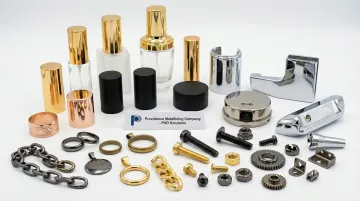
Providence Metallizing Company has offered advanced PVD finishing — including Titanium Nitride (TiN), Zirconium Nitride (ZrN), and Titanium Aluminum Nitride — since the 1980s. PMC holds approved supplier status with Estée Lauder, L'Oreal, Avon, and Elizabeth Arden. One capability that distinguishes PMC in multi-material projects: the ability to match PVD finishes across both metal and plastic substrates, ensuring visual consistency across an entire assembly.
What is Powder Coating?
Powder coating is a dry finishing process where electrostatically charged polymer powder — polyester, epoxy, polyurethane, or acrylic — is sprayed onto a grounded metal surface. The coated part then cures in an oven, where the powder melts into a smooth, hard, protective layer.
Unlike PVD, powder coating operates at room temperature before curing and requires no vacuum environment.
From an efficiency and environmental standpoint, powder coating has clear advantages:
- Oversprayed powder is captured and recirculated, pushing material utilization rates to 90–95%, with optimized systems exceeding 98%
- Contains no solvents and emits zero or negligible VOCs, making it cleaner than liquid paints
- Lower operating costs at scale due to minimal waste and no solvent disposal requirements
Powder coating limitations for premium applications include:
- Cannot replicate true metallic finishes with the depth and reflectivity of PVD
- Thicker film build (50–150 microns) may affect dimensional tolerances on precision parts
- UV exposure can cause gradual color fading on some formulations
- Not ideal for plastic substrates without extensive surface preparation due to high curing temperatures (150–200°C)
These constraints aside, powder coating excels anywhere coverage consistency, weather resistance, and cost efficiency take priority over decorative precision.
Where Powder Coating Gets Specified
It's the go-to finish across a wide range of high-volume, durability-first applications:
- Structural steel — beams, brackets, and frames requiring corrosion protection
- Appliance exteriors — refrigerators, washers, and dryers
- Aluminum architectural profiles — window frames and curtain walls
- Automotive chassis, bumpers, and wheels
- Outdoor furniture and fencing exposed to UV and moisture
- Bicycle frames across road, mountain, and commuter categories
PVD vs Powder Coating: Which One Should You Choose?
The right coating choice depends on five key factors: substrate material, required finish appearance, end-use environment, production volume, and acceptable cost per part.
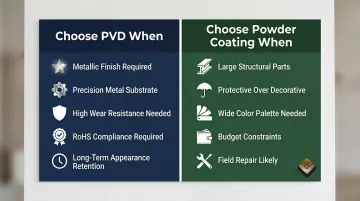
Choose PVD when:
- Premium metallic finish is required — cosmetic packaging, luxury hardware, high-end consumer goods
- Substrate is stainless steel or precision-machined metal — PVD's thin coating preserves tight tolerances
- High contact frequency or wear resistance is critical — door handles, tools, watch cases
- RoHS compliance and environmental certifications are required — zero VOC, no hazardous substances
- Long-term appearance retention justifies higher upfront cost — reduced replacement cycles offset initial investment
Choose powder coating when:
- Coating large or structurally complex steel/aluminum parts at scale — industrial and architectural applications
- Application is primarily protective rather than decorative — corrosion and weather resistance are priorities
- Wide palette of custom colors or textures is needed — matte, gloss, satin, textured finishes
- Budget constraints require lower per-unit cost — high material utilization and efficiency
- Field repair of coating damage is likely — powder coating can be touched up or recoated
The Hybrid Approach
Some high-end products use powder coating as a base layer for color, then add a PVD topcoat for surface hardness and metallic sheen. This hybrid approach carries real technical risk. The high-vacuum and thermal conditions of PVD can cause polymers to outgas, leading to poor adhesion, blistering, and severe cracking. To avoid this, the polymer base must be fully crosslinked — typically by baking epoxy at 210°C — before any PVD deposition begins.
Real-World Example: Cosmetic Perfume Cap Decision
When the technical factors are clear, working through a real scenario makes the decision straightforward. Consider a cosmetic brand evaluating coatings for a perfume bottle cap requiring:
- Premium gold finish with long-term appearance retention
- Scratch and fingerprint resistance for retail display
- RoHS compliance for clean-beauty standards
Decision logic:
- True metallic gold depth and reflectivity rules out powder coating entirely
- High retail handling demands scratch resistance powder coating cannot consistently deliver
- RoHS compliance points to PVD's zero-VOC, solvent-free process
- Metal or high-grade plastic substrates are fully compatible with PVD application
- Premium product positioning supports the higher per-unit cost
Recommendation: PVD coating (Titanium Nitride gold variant)
Providence Metallizing Company has applied PVD finishes for brands like Estée Lauder, L'Oreal, and Elizabeth Arden — including exactly this type of perfume packaging application. PMC provides free sampling for most finishing evaluations. Reach out at 401-722-5300 or inquiries@providencemetallizing.com to request samples for your specific part.
Conclusion
The right coating comes down to what your product demands. PVD delivers on durability, finish quality, and regulatory compliance — making it the go-to for precision and decorative applications. Powder coating leads on cost, versatility, and throughput for industrial and architectural work. Your specific functional and aesthetic requirements should drive the decision.
For manufacturers in cosmetics, jewelry, or high-end hardware, PVD can reduce long-term replacement costs, elevate perceived product value, and meet sustainability requirements. Powder coating remains the better fit where broad coverage, custom color options, and cost efficiency take priority.
If your application calls for PVD finishing, Providence Metallizing Company has offered PVD coating services — including Titanium Nitride, Zirconium Nitride, and Chrome Nitride — since the 1980s, with deep experience serving cosmetic, jewelry, and hardware manufacturers.
Frequently Asked Questions
What is the difference between PVD coating and powder coating?
PVD is a vacuum-based metallic deposition process producing a thin (1–5 micron), ultra-hard film with exceptional scratch and corrosion resistance. Powder coating is an electrostatic spray-and-bake polymer process producing a thicker, more flexible coating. The key differences are finish type (metallic vs. colored polymer), durability level, and suitable application environments.
Is PVD coating more durable than powder coating?
Yes, PVD is generally harder and more scratch- and corrosion-resistant than powder coating, making it longer-lasting in high-wear or high-contact applications. However, powder coating offers better repairability and is sufficient for many standard industrial uses where extreme hardness is not required.
How long does PVD plating last?
High-quality decorative PVD coatings can last from 10 years to the lifetime of the product, depending on substrate and environment. Major architectural hardware manufacturers offer 10-year to lifetime limited warranties on PVD finishes. Industrial PVD coatings on cutting tools extend lifespan by 2x to 10x compared to uncoated surfaces.
Can PVD coating be repaired if scratched?
No. Because PVD is molecularly bonded to the substrate, scratches cannot be spot-repaired. The process requires a controlled, high-vacuum chamber environment that cannot be replicated in the field, so damaged parts must be stripped and fully recoated.
Which coating is more environmentally friendly?
Both are strong choices. PVD uses no harmful chemicals or solvents and produces zero VOC emissions. Powder coating also produces zero VOCs with material utilization rates above 95%, making both significantly cleaner than traditional liquid paint or hexavalent chromium electroplating.
Can powder coating be applied to plastic substrates?
Powder coating is primarily designed for metal substrates and is technically challenging to apply to plastics due to high curing temperatures (150–200°C) that can deform heat-sensitive plastics like ABS and PC. PVD, by contrast, can be applied to a broader range of substrates including certain plastics and engineering-grade polymers like Ultem, Nylon, and LCP when properly prepared.