Introduction
For manufacturers, brand owners, and product designers, choosing scratch-resistant coating is more than a surface treatment decision—it's a calculation that affects product lifespan, customer perception, and warranty costs. When a luxury cosmetic compact arrives with scratches from bulk packaging, or when industrial hardware shows wear after minimal handling, the real cost becomes clear: returns, refinishing, and brand damage.
Those costs make the pricing conversation worth getting right. Scratch-resistant coating quotes vary widely based on coating type, substrate material, production volume, and application method — and a common mistake is confusing per-piece cost with total cost. A quote showing $0.05 per part may mask $500 in setup fees, while a $2.00 per-piece price might include full tooling and testing.
Understanding where that number comes from — and what drives it up or down — is what determines whether the investment actually pays off.
Key Takeaways
- Scratch-resistant coating costs range from under $0.10 per piece at high volume to $2–$5+ for specialized low-volume applications
- Coating type, substrate material, volume, and surface prep drive final pricing
- UV topcoats suit cosmetic packaging and consumer goods; PVD hard coats serve automotive, industrial, and engineering applications
- Skipping coating generates higher costs through returns, refinishing, and brand damage
- Matching coating to performance demands — not just price — determines long-term value
How Much Does Scratch Resistant Coating Cost?
There is no single price for scratch-resistant coating. The category spans multiple technologies applied to different materials at vastly different scales — a per-piece cost on a million-unit cosmetic run looks nothing like a quote for low-volume precision instrument components.
Common budget mistakes include:
- Underbudgeting by focusing only on per-piece cost
- Choosing the wrong coating technology for the application
- Getting blindsided by setup, tooling, and surface prep charges not included in the initial quote
Typical Cost Ranges
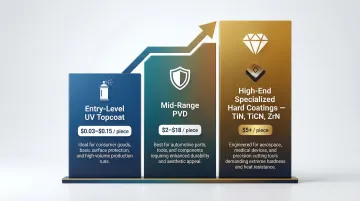
Entry-Level UV Topcoat / Basic Hard Coat:
- Approximately $0.03 per square foot for 100% solids UV coating at 1.0 mil thickness
- $0.05–$0.15 per piece for high-volume consumer goods (setup costs amortized across large runs)
- $85–$150 per part for prototype quantities (10 pieces), dropping to $25–$45 at 100-piece batches
Mid-Range Multi-Layer UV or Standard PVD:
- $2–$15 per piece for outsourced PVD on small components
- $8–$18 per part for 1,000+ piece production runs with optimized racking
High-End Specialized Hard Coatings (TiN, TiCN, ZrN, CrN):
- Approximately $5.00 per part for standard AlTiN coating on precision tooling
- $0.09–$0.15 per part for in-house high-volume PVD on small components in 96–256 part batches
Entry-Level / UV Topcoat Systems
Basic UV-cured scratch-resistant topcoat applied over plastic or metallized substrates. Single-pass application suited for glossy or matte finishes, with no extended surface prep or multi-layer complexity.
Best For:
- High-volume cosmetic packaging
- Writing instruments
- Decorative hardware
- Plastic consumer products where surface aesthetics and moderate scratch protection are primary goals
Dymax OC-3021 achieves 5H pencil hardness on PMMA, 3H on PET, and 2H on polycarbonate, with 90D durometer hardness at 2–5 µm thickness — solid performance for cosmetic and consumer applications at scale.
Mid-Range / Multi-Layer UV or Standard PVD
This tier covers enhanced UV topcoat systems with adhesion primers, or entry-level PVD coatings with scratch and wear resistance. Surface prep steps are included.
Typical applications include automotive trim, plumbing fixtures, branded luxury packaging, and hardware needing durable, consistent finishes across large production runs.
One technical factor worth knowing: for challenging substrates like polycarbonate, atmospheric plasma treatment drops contact angles from 80° to 43°, substantially improving UV coating adhesion. This step adds cost — but it's often the difference between a coating that lasts and one that delamminates.
High-End / Specialized Hard Coatings
At the top tier, you're looking at advanced PVD (TiN, TiCN, ZrN), CVD, or engineered multi-layer coatings with tightly controlled thickness and hardness specs. Extended surface prep, testing, and quality validation are built into the process.
PVD coatings deliver microhardness levels that UV topcoats can't approach:
| Coating | Microhardness (HV) |
|---|---|
| TiN | 2,000–3,000 |
| TiCN | 2,800–3,800 |
| ZrN | 2,500–2,700 |
| CrN | 1,400–2,500 |
These specs matter for industrial components, medical instruments, engineering-grade plastics (Ultem, Nylon, LCP), and any precision part where coating failure carries real consequences.
Key Factors That Affect the Cost of Scratch Resistant Coating
The final price is shaped by technical, operational, and volume-related variables. Understanding these helps buyers request accurate quotes and avoid unexpected cost additions.
Coating Technology Type
The spectrum runs from UV topcoats (lower cost, well-suited for plastic and cosmetic substrates) to PVD hard coatings (higher cost, greater hardness and wear resistance) to CVD and hybrid systems.
Decision Drivers:
- Required hardness: Pencil hardness or Mohs scale requirements
- Chemical resistance: Exposure to solvents, fragrances, or cleaning agents
- Substrate compatibility: Plastic, metal, glass, or engineered resins
UV topcoats max out at 5H pencil hardness (approximately 90D durometer). PVD transition-metal nitrides deliver 1400-3800 HV—off the scale for pencil hardness testing and unsuitable for that test method.
Substrate Material and Condition
The material being coated—ABS plastic, polycarbonate, engineering-grade resins, zinc alloy, glass—affects surface preparation requirements, primer compatibility, and adhesion difficulty.
Engineering plastics add meaningful process complexity. Each material type introduces specific requirements:
- Ultem (PEI): Requires dedicated surface conditioning before coating adhesion is achievable
- LCP: Needs low-pressure O2 plasma pretreatment to improve wettability for PVD layers
- Nylon: Low surface energy demands plasma treatment to break molecular bonds and create reactive surfaces
Metal substrates carry their own challenges. Aluminum's tenacious oxide layer typically requires chromate conversion coatings (Alodine/Chem Film) or aggressive sputter etching before any coating can be applied.
Production Volume and Run Size
Setup costs—jigging, masking, equipment calibration—are largely fixed, so high-volume runs spread those costs across more parts, which drives per-piece pricing down significantly.
Volume pricing typically follows this pattern:
| Run Size | Approximate Per-Part Cost |
|---|---|
| 10 parts (prototype) | $85–$150 |
| 100 parts | $25–$45 |
| 1,000+ parts | $8–$18 |
Job shops also enforce minimum lot charges. PVD coating services commonly set a $150 minimum regardless of piece count — a factor worth confirming before requesting prototype quotes.
Level of Customization and Finish Specification
Standard finishes (clear UV topcoat, matte, gloss) cost less than custom color-matched PVD finishes, multi-layer architectural looks, or finishes that must match companion metal and plastic components.
Matching finishes across substrate types—metal vs. plastic—typically requires additional development cycles and process steps. Providence Metallizing, for example, offers over 30 finishes on plastic substrates and routinely matches metal finishes on plastic components for cosmetic and hardware customers. That kind of cross-substrate consistency adds process complexity and, by extension, cost.
Surface Preparation Requirements
Parts arriving with contamination, mold release agents, poor surface quality, or dimensional variation require pre-treatment steps that add labor and time.
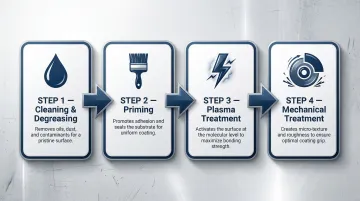
Common Prep Steps:
- Cleaning and degreasing
- Priming
- Plasma treatment for adhesion promotion
- Mechanical treatment (grinding, polishing)
Surface prep is one of the most common sources of unexpected line items in a coating quote. Specifying part cleanliness and surface condition upfront gives suppliers what they need to price accurately.
Cost Breakdown of Scratch Resistant Coating
The total cost goes well beyond the per-piece coating fee. Buyers planning a coating program need to account for all cost categories to budget accurately.
1. Setup and Tooling One-time costs for jigs, fixtures, masking tools, and process development specific to part geometry. Amortization varies with production volume.
2. Surface Preparation Variable cost depending on substrate condition. May include cleaning, priming, plasma treatment, and pre-treatment steps.
3. Coating Application The recurring per-piece or per-batch cost tied to materials, machine time, and labor. For high-volume powder coating, this breaks down as: Material (14.5%), Labor (18.8%), Variable Burden (8.7%), and Fixed Cost (58%).
4. Quality Control and Testing Adhesion testing (ASTM D3359), scratch/abrasion testing (ASTM D4060), and inspection steps may be included or billed separately.
5. Rejects and Rework Often overlooked, the cost of non-conforming parts should be factored into total unit economics. Typical reject rates in job shops run around 5%, often due to light coating or orange peel defects.
That reject-rate exposure ties directly into volume economics. At high production runs, setup and tooling costs spread thin — per-piece costs drop significantly. A low-volume trial run may look expensive by comparison, but that's a one-time development cost, not a permanent price signal. Budget for both phases separately to avoid misreading the true unit economics.
Low-Cost vs. High-Cost Scratch Resistant Coating — What's the Difference?
"Cheaper" and "better value" are not the same thing in coating. A budget UV topcoat and a premium PVD hard coat differ on price, yes — but more critically, on performance, lifespan, and which applications each can actually handle.
| Performance Metric | UV Hardcoat (Acrylated Urethane) | PVD Hard Coating (TiN, TiCN, ZrN, CrN) |
|---|---|---|
| Pencil Hardness | 2H - 5H (substrate dependent) | Off scale - not suitable for pencil test |
| Vickers Hardness | ~90D Durometer | 1400 HV - 3800 HV (14-38 GPa) |
| Coating Thickness | 2-5 µm | 1-10 µm |
| Abrasion Resistance | 200 MEK Double Rubs | Coefficient of Friction: 0.2-0.7 (dry vs. steel) |
| Best Use Cases | Cosmetic packaging, consumer goods, writing instruments | Industrial tooling, medical instruments, automotive components |
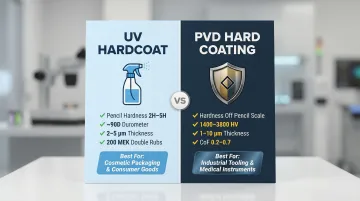
The numbers above tell part of the story. The practical implications tell the rest.
UV hardcoats offer cost-effective protection for indoor use and moderate handling. They also maintain consistent finish across high-volume production runs — a key consideration for cosmetic packaging and consumer goods. PVD coatings operate in a different category entirely: extreme hardness, chemical resistance, and service life measured in years rather than months.
Finish consistency is another gap. PVD coatings can be applied at tightly controlled thicknesses, which matters for precision applications in medical instruments or automotive components where tolerances are non-negotiable.
The clearest way to frame the cost difference: the cheapest coating per piece often produces the highest cost over the product's lifetime. A $0.10 UV topcoat that fails in six months — triggering returns, rework, or brand damage — costs more in practice than a $2.00 PVD coating that outlasts the product itself.
How to Estimate the Right Budget for Scratch Resistant Coating
A useful budget starts with understanding the product's end-use demands, not with a target price. Mismatches between coating specification and application requirements are the most common source of wasted spend.
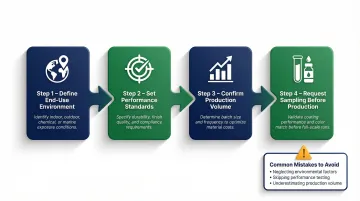
Key Questions to Answer Before Requesting Quotes:
- What is the end-use environment — indoor display, outdoor exposure, frequent physical contact, or chemical exposure?
- What performance standard must the coating meet — abrasion cycles, pencil hardness rating, or cross-hatch adhesion test?
- What is the expected production volume, and how will it scale over time?
- Does the coating need to match or complement finishes on other components, such as metal-to-plastic color and sheen alignment?
Common Cost-Estimation Mistakes to Avoid:
- Focusing only on per-piece cost and ignoring setup and tooling costs
- Choosing the cheapest coating technology without confirming substrate compatibility
- Over-specifying a premium hard coat for a low-abrasion consumer application
- Failing to test adhesion before committing to full production
The Case for Sampling Before Production
Working with an experienced finishing partner who offers sampling before production lets buyers validate coating performance and refine cost estimates before placing volume orders. Providence Metallizing, for example, offers free sampling for most applications — so manufacturers can test adhesion, durability, and finish quality on actual parts before locking in production volumes.
The right budget balances upfront coating cost against downstream savings in returns, rework, and brand protection. A coating that fails in the field costs far more than the premium avoided at the quoting stage — in recalls, customer complaints, and brand damage that's difficult to reverse.
Frequently Asked Questions
How much does scratch resistant coating cost?
Cost varies widely by coating technology, substrate, and volume. High-volume production drives per-piece costs down sharply—fixed overhead spreads across more units.
How much does anti-reflective coating cost?
Anti-reflective coatings for eyeglass lenses typically cost $38-62 per pair wholesale and $75-150 retail for premium versions. For industrial display covers and touch panels, AR coated glass ranges from $1.78-11.50 per square meter depending on light transmittance specifications and order quantities.
Is scratch-resistant coating worth it for glasses?
For eyeglass lenses, scratch-resistant coating is essential—most plastic lens materials are soft and unprotected without it. Quality coatings last 2-3 years with proper care, making the upfront cost minor compared to early lens replacement.
How long does scratch resistant coating on glasses last?
Quality scratch-resistant coatings last the life of the prescription—28-30 months on average. For industrial UV topcoats and PVD coatings on manufactured parts, well-matched coatings typically outlast the product's full service life.
What is the most scratch-resistant material for glasses?
Polycarbonate with hard coating and high-index lenses with premium scratch-resistant treatment offer the best protection for eyewear. For industrial parts, PVD hard coatings like TiN (2000-3000 HV) or TiCN (2800-3800 HV) represent the highest hardness options for metal and engineering plastic substrates.